Systematic sustainability: ISCC PLUS certification
The requirements for sustainable solutions in industry are growing ever more stringent, driven both by regulatory requirements and growing environmental awareness among customers and markets. By pursuing ISCC PLUS certification, IGP Powder Coatings is taking a key step toward integrating sustainable raw materials into the supply chain in a transparent and compliant manner. In the following interview, IGP experts explain the opportunities this creates for products and markets, what the certification means, and the tangible added value it offers customers.
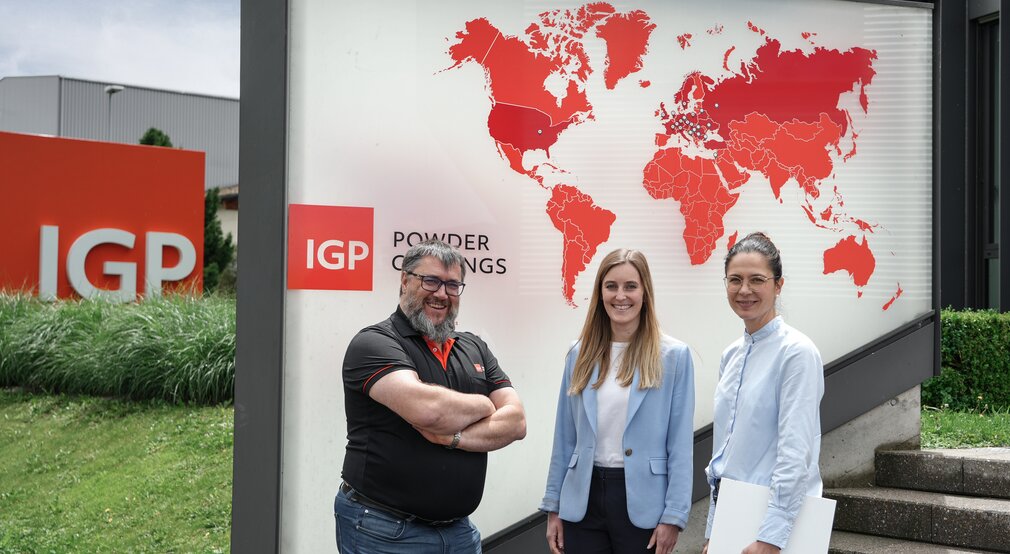
Caption: Cornelia Tannheimer talks with IGP experts Birte Stocker and Marcel Perret about the benefits of ISCC PLUS certification. From left to right: Marcel Perret (IGP Safety Officer & Quality Management Expert), Birte Stocker (IGP Product Manager, Architecture),
Cornelia Tannheimer (IGP Corporate Communications Manager).
ISCC stands for “International Sustainability and Carbon Certification” and was founded in 2010 as a multi-stakeholder initiative. This globally recognized, voluntary certification system promotes transparent and sustainable supply chains, as well as the circular economy and bioeconomy.
IGP Powder Coatings is working toward ISCC PLUS certification so that bio-based and bio-circular raw materials can be used in powder coatings with full compliance and traceability. Once this certification has been obtained, annual independent audits will ensure adherence to all processes, complete documentation, and full traceability of material flows.
A word from our experts – firsthand insights
In the following interview, Cornelia Tannheimer (IGP Corporate Communications Manager) speaks with Birte Stocker (IGP Product Manager Architecture) and Marcel Perret (IGP Safety Officer & Quality Management Expert) about the opportunities the certification creates for products, markets, and customers.
Cornelia Tannheimer (CT): What does ISCC PLUS certification mean for IGP?
Marcel Perret (MP): “By pursuing ISCC PLUS certification, we are creating the basis for integrating alternative sustainable raw materials into our products via a mass balance approach – with full transparency, traceability, and regulatory compliance. This will allow us to gradually replace fossil-based raw materials, actively contribute to the bioeconomy, and support the reduction of CO2 emissions along the value chain.”
CT: What specific assurances or evidence does the certification provide?
MP: “ISCC PLUS certification confirms the correct application and complete documentation of the mass balance approach, as well as compliance with all relevant system and process requirements. This is verified through annual independent audits by accredited certification bodies. In this way, sustainability claims are substantiated transparently, credibly, and in accordance with the relevant requirements.”
CT: What makes products that use ISCC PLUS-certified, mass-balanced raw materials different?
Birte Stocker (BS): “These products are based on polyester resins that, under the mass balance approach, are assigned a high share of bio-based and bio-circular raw materials. This enables us to replace a substantial proportion of petroleum-based resources across the value chain and achieve a clear reduction in the powder coating’s carbon footprint.”
CT: How does IGP ensure compliance with sustainability standards along the entire supply chain?
BS: “IGP uses ISCC PLUS certification to ensure that sustainability requirements are met consistently across the supply chain. This certification provides full transparency and traceability throughout the value chain, in part through the recognized mass balance approach and binding sustainability declarations from all partners involved. At the same time, the certified system reliably prevents what is known as double claiming – where the same sustainable raw materials are marketed more than once within the supply chain – thereby safeguarding the credibility and integrity of our sustainability performance.”
CT: Which industries and applications benefit most from products with mass-balanced raw materials?
BS: “Primarily industries with demanding sustainability requirements. Above all, the architecture and construction sectors, for example in façade applications and window and door systems. Wherever long-lasting powder coatings with a reduced carbon footprint, reliable performance, and a certified contribution to the bioeconomy are required, these products offer clear added value.”
CT: How will IGP continue to develop its range of sustainable solutions?
BS: “IGP is continuously developing its product range in line with its defined portfolio strategy. Key elements include the systematic implementation of low-temperature technology, the integration of sustainable raw materials through the mass balance approach, and the continued development of PFAS-free powder coating solutions.”